
Why Executives Are Choosing Private Wellness Experiences
High-performing executives are moving away from shared-itinerary getaways and standard corporate wellness perks toward fully private, personalized wellness experiences, and the reason isn't indulgence. It's that generic wellness benefits and group-based trips were never built to address what's actually depleting senior leaders: an unrelenting volume of consequential decisions, constant visibility, and very little genuine privacy. A private wellness experience solves for exactly that, with full discretion, a program built around one person, and nothing left to plan.
The short answer: Executives aren't choosing private wellness experiences because it's trendy. They're choosing them because decision fatigue and constant visibility are specific, well-documented drains that generic, group-based wellness perks were never designed to solve.
The Exhaustion Behind the Shift
Stress at the top is rising, not falling. Development Dimensions International's Global Leadership Forecast 2025, which surveyed nearly 10,800 leaders across levels worldwide, found that 71 percent of leaders reported increased stress, up from 63 percent in 2022. That's notable because leadership roles typically come with the most resources, flexibility, and support available in an organization. If stress is climbing there too, the cause isn't a lack of access to standard wellness benefits.
Broader research on burnout by seniority level tends to show C-suite executives reporting burnout at somewhat lower rates than middle management, but with a different profile entirely. Where burnout among individual contributors and mid-level managers often shows up as disengagement and exhaustion: Executive burnout tends to present as decision fatigue, strategic paralysis, and a rising aversion to risk.
Executive Burnout Doesn't Look Like Other Burnout
The World Health Organization's framework for burnout, exhaustion, cynicism, and reduced professional efficacy still applies at the executive level. But research focused specifically on senior leaders points to a more particular mechanism underneath it: the sheer volume of consequential decisions made without pause, day after day, with real weight behind each one.
A few dynamics compound it further. There's the autonomy paradox, greater formal authority paired with less actual control over one's own time and calendar. There's the expectation of near-constant availability. There's professional isolation, since peers at the same level are often competitors or direct reports rather than confidants. And there's a form of emotional labor unique to leadership: projecting steadiness and certainty regardless of what's actually happening internally.
None of that is solved by a spa day or a wellness stipend.
Why Generic Wellness Perks Don't Reach This
Corporate wellness benefits have expanded substantially over the past few years, but usage tells a different story than investment does. Broader workforce research has found that while the vast majority of employees say mental health benefits matter to them, only a small fraction have actually used them, largely because of unclear access rather than lack of interest.
At the executive level, that gap tends to widen further, and visibility is usually why. Using a company-branded wellness benefit or attending a group session carries a different kind of risk for a senior leader than it does for most employees: being seen as struggling, in a role where composure is often treated as a job requirement. Layer on a workload defined by an outsized number of high-stakes decisions each day, and a wellness format built for a general population starts to feel mismatched from the start.
The Case for Full Privacy
Recent research on luxury travel points to something consistent: high-net-worth travelers are increasingly avoiding shared, crowded settings in favor of private, exclusive ones, driven by a genuine need for undisturbed space rather than status alone. One recurring theme across 2026 wellness and luxury travel research frames it simply: luxury is no longer about access to everything. It's the freedom to step away from the noise entirely.
For an executive, that reframes wellness as something closer to protected infrastructure than comfort, in the same category as confidentiality or security. A shared-schedule getaway, with other guests, communal spaces, and a fixed group itinerary, adds a layer of social performance that works against the very recovery someone is seeking. Full privacy removes that layer. There's no one to read the room for, no schedule to negotiate, and no version of oneself to maintain in front of strangers.
The Data Behind the Trend
This isn't a niche preference. According to the Global Wellness Institute, the global wellness economy surpassed $6.8 trillion in 2025 and is projected to approach $9 trillion by 2028, making it one of the fastest-growing sectors worldwide. Wellness tourism alone is expected to exceed $1.4 trillion. Across nearly every current analysis of luxury travel, personalization and privacy come up as the defining shift for 2026, not as an add-on feature but as the actual product.
Executives investing in fully private wellness experiences are part of that larger recalibration of what luxury means: less about material excess, more about control over time, pace, and privacy.
What This Looks Like in Practice
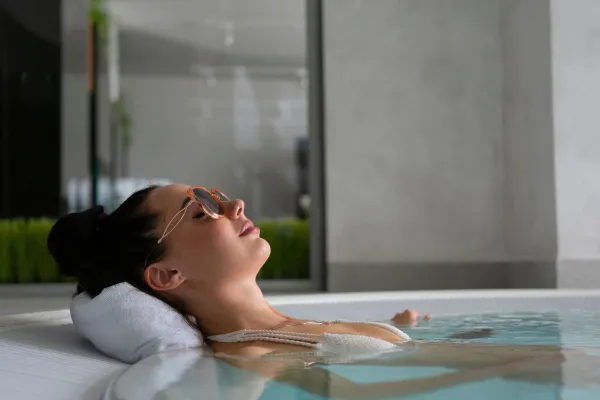
In practical terms, a private wellness experience tends to share a few consistent traits. A property reserved for one guest or one traveling party, not shared with strangers. Sessions built around one person's energy and schedule rather than a fixed group itinerary. No requirement to choose between programmed activities or coordinate around anyone else's plans. Practitioners working one-on-one rather than in a class format.
There's no communal breakfast hour to plan around, no shared spa schedule to book into. Just quiet, at one's own pace, with nothing left to arrange. The goal was never more amenities. It was fewer decisions and less exposure, precisely the two things a demanding leadership role rarely allows.
So, Why Are High-Performing Executives Choosing This
Because the exhaustion they're dealing with is specific. Decision fatigue, hypervisibility, and a scarcity of genuine privacy. Group getaways and standard wellness perks were never designed to solve for any of the three. Something fully private, fully personalized, with nothing left to plan or perform, is.
Frequently Asked Questions
Why are executives moving away from traditional corporate wellness perks?
Most corporate wellness benefits are designed for a general workforce and see low uptake among executives, largely due to visibility concerns and a workload that differs in both volume and stakes. Private wellness experiences don't require being seen using a shared or company-branded benefit.
What's the real difference between a private wellness experience and a group wellness getaway?
A group getaway is shared with other guests and follows a set schedule of communal activities. A private wellness experience is reserved for one person or one traveling party, with the pace and services built entirely around them and nothing to coordinate.
Is this shift actually data-backed, or is it a lifestyle trend?
Both. Leadership stress has measurably increased, with 71 percent of leaders reporting higher stress in 2025 versus 63 percent in 2022, and the global wellness economy, now valued above $6.8 trillion, is growing specifically within the personalized and private segment.
How is executive burnout different from typical workplace burnout?
Executive burnout tends to present as decision fatigue, strategic paralysis, and risk aversion rather than straightforward disengagement, driven largely by an outsized volume of consequential daily decisions and constant visibility rather than task overload alone.
Is privacy really that important, or is this mostly about luxury amenities?
For most executives, it's functional rather than indulgent. Removing shared spaces and group schedules eliminates the social performance that can undercut genuine recovery, which is a significant part of why fully private formats are gaining ground over standard group-based options.
None of this is really about wanting more. It's about wanting less to manage. For someone whose job is making hundreds of decisions under pressure, the highest form of rest may simply be a few days where none of that is required of them at all.
